
FULL THROTTLE AHEAD
WILL A SMALL PILL BE ONE OF THE FIRST?
The international Huntington’s disease (HD) community has been waiting a very long time for its first disease-modifying treatment — a treatment that could slow, stop, or potentially reverse the progression of HD.
As a rare disease community, we are fortunate to have several players at the table. The frustrating part is that developing these treatments takes time.
But one of the most interesting stories began with something very small: a pill.
Where it all began
Let’s start at the beginning.
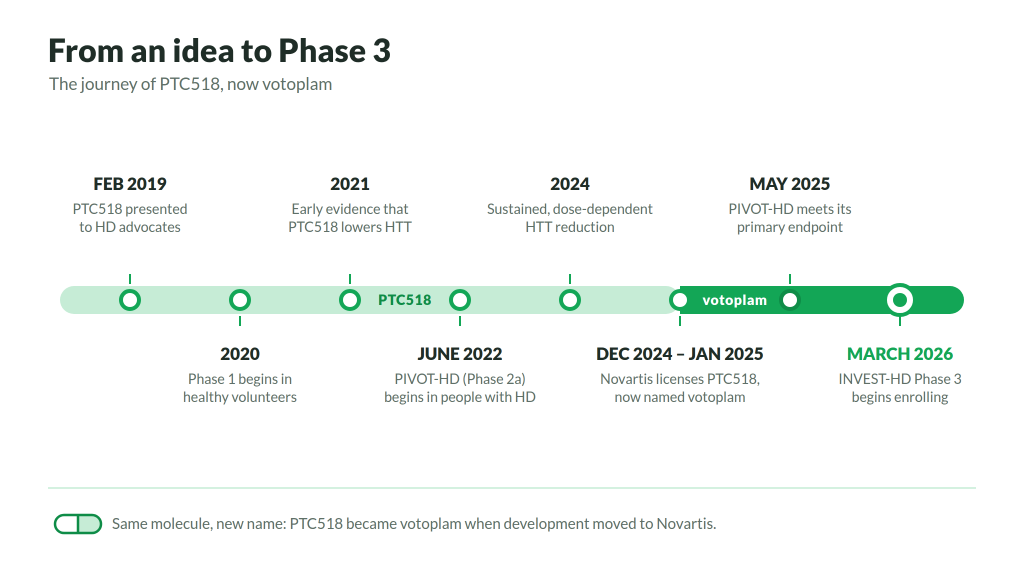
In February 2019, a group of HD advocates heard Dr. Anu Bhattacharyya present what PTC Therapeutics was developing. She described a small molecule, PTC518, that could potentially reduce the production of huntingtin protein(HTT) and, ultimately, slow the progression of HD.
At the time, it sounded almost too good to be true.
Fast-forward seven years, and that same medicine — now known as votoplam — has progressed from an early idea to a global Phase 3 clinical trial.
That is quite a journey.
PTC stands for Post-Transcriptional Control, referring to the way the company’s technology can influence how RNA is processed inside cells.
Where did the idea come from?
The story actually started with another neurological disease: SMA.
PTC Therapeutics was developing medicines for SMA and had learned how to influence the way cells process RNA.
At around the same time, Novartis was developing a drug called branaplam, also for SMA. Scientists discovered that branaplam unexpectedly affected the processing of HTT RNA, the RNA molecule that provides instructions for making huntingtin protein. This was an important discovery.
It showed that it was possible, using a small molecule, to alter the way the cell processes HTT RNA — and therefore potentially reduce the amount of HTT being produced.
Branaplam was subsequently investigated in an HD clinical trial. Unfortunately it was discontinued after concerns about nerve damage emerged. But the underlying scientific idea remained.
PTC Therapeutics essentially asked:
If a small molecule can alter HTT RNA, could we develop our own molecule specifically designed to do this in HD?
And that is what they set out to do.
Many molecules were tested. The most promising candidates were repeatedly refined and improved. Eventually, one emerged: PTC518.
So, how does PTC518 work?
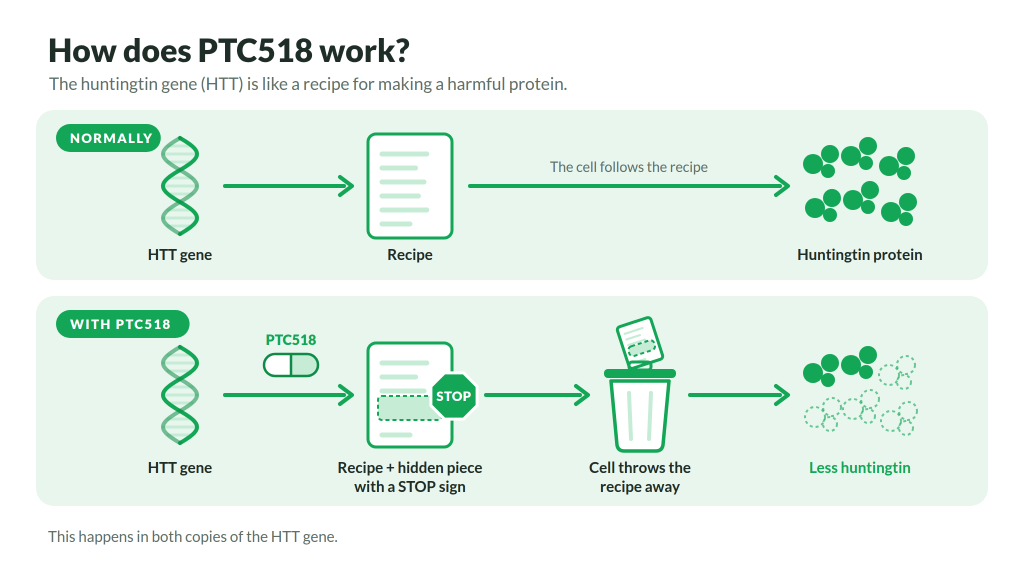
Imagine the Huntington’s disease gene (HTT) is a recipe for making a harmful protein.
Normally: HTT → recipe → huntingtin protein.
Scientists found a hidden piece in the HTT recipe.
PTC518 makes the cell put that hidden piece into the recipe.
That hidden piece contains a STOP sign.
So: HTT → recipe + STOP sign → cell throws the recipe away → less huntingtin (this happens in both copies of the gene)
The journey from an idea to Phase 3
The development of PTC518 has moved through several important stages.
2020 — Phase 1 begins
PTC Therapeutics began the Phase 1 clinical trial of PTC518 in healthy volunteers.
Assess its safety and biological effects.
2021 — Early evidence
Phase 1 results provided evidence that PTC518 could reduce HTT levels. This supported taking the programme forward into people living with HD.
June 2022 — PIVOT-HD begins
The PIVOT-HD Phase 2a trial began in people with HD.
This was an important step: the drug was no longer simply an interesting laboratory concept. It was now being tested in the people it was ultimately intended to help.
2024 — Encouraging results
Results from PIVOT-HD showed sustained, dose-dependent reductions in huntingtin protein.
There were also encouraging trends in several clinical measures.
However, it is important to remember that these were early-stage results. A reduction in HTT is encouraging, but the critical question is whether that biological effect = a meaningful slowing of HD progression.
And that is exactly what a Phase 3 trial is designed to determine.
December 2024 / January 2025 — Novartis enters the picture
Then came another major development.
Novartis and PTC Therapeutics entered into a global licensing and collaboration agreement for PTC518.
The programme moved under Novartis, and PTC518 was given a new name: votoplam. Novartis took responsibility for the continued development, manufacturing and, ultimately, commercialization of the medicine.
In many ways, it felt like the story had come full circle.
Remember branaplam?
Novartis had originally been involved in discovering that a small molecule could influence HTT RNA.
Now, years later, Novartis was taking forward a different molecule — one developed specifically from that scientific insight and refined for HD.
May 2025 — PIVOT-HD results
The PIVOT-HD study produced another important milestone.
The trial met its primary endpoint, demonstrating a significant reduction in blood huntingtin protein.
Again, these results were encouraging — but they did not yet prove that votoplam slows the progression of Huntington’s disease.
That question requires a much larger and longer study.
And that brings us to today.
2026
In March 2026, the INVEST-HD Phase 3 trial began enrolling participants.
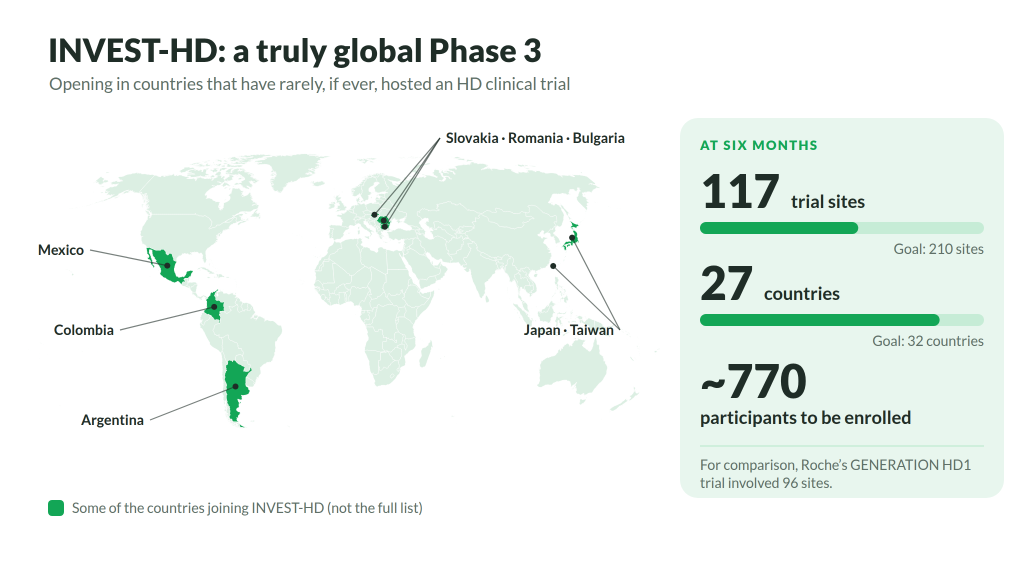
The purpose of INVEST-HD is to determine whether votoplam can actually slow the progression of HD. And the scale of this trial is impressive: at the six-month mark, Novartis had opened 117 trial sites across 27 countries, with the aim of reaching 210 sites in 32 countries and enrolling approximately 770 participants.
To put that into perspective, the Roche GENERATION HD1 trial ultimately involved 96 sites.
The speed and geographical reach of INVEST-HD are remarkable.
The trial is opening in countries and regions that have rarely, if ever, had the opportunity to participate in an HD clinical trial — including countries such as Bulgaria, Romania, Slovakia, Japan, Taiwan, Argentina, Colombia and Mexico.
For the global HD community, that matters.
It means more families have the opportunity to participate in research, and it demonstrates the scale at which this programme is now being developed.
Hence the title:
FULL THROTTLE AHEAD
But let's keep our feet on the ground
There is an understandable sense of excitement around votoplam, science is compelling, reduction in huntingtin protein is encouraging, speed and scale of the Phase3 are impressive.
And, perhaps most importantly, there is now a serious global effort to answer the question: Can we actually slow Huntington’s disease?
But we still have to wait.
The INVEST-HD study itself is expected to run for approximately three years, followed by analysis of the results.
So we are still some distance away from knowing whether votoplam will become a disease-modifying treatment for HD.
And that distinction is important: Promising is not the same as proven.
At the same time, there are many other approaches being developed across the HD field — from gene silencing and gene therapy to other ways of targeting huntingtin, inflammation, cellular pathways and the underlying biology of the disease.
That is something we should celebrate.
Because the future of HD treatment does not necessarily depend on one single drug.
As we have seen in other diseases, different treatments may work better for different people, at different stages of disease, or through different mechanisms.
For now, the HD community can allow itself a little optimism.
A small pill that began as an intriguing scientific idea has travelled a very long way.
From PTC518…
to votoplam…
from an idea presented to advocates in 2019…
to a global Phase 3 trial in 2026.
We don’t know yet whether this will be the breakthrough we have been waiting for.
But for the first time, the question is no longer simply:
“Could this work?”
We are now much closer to finding out.
And that, in itself, is something worth watching.
Full throttle ahead.
– Article written by Dina de Sousa
